As I was reading DJ Waldie’s Becoming Los Angeles: Myth, Memory, and a Sense of Place, I came across one particular essay that hit close to home — literally.
“A 2015 report to the Los Angeles Cultural Heritage Commission, in a filing to give historical status to an Edwardian-era house, named its location as Angelino Heights, Angeleno Heights, and Angeleño Heights almost interchangeably. Naming the heights—the city’s first suburb in 1886—lays a sequence of mutating demonyms on the landscape of Los Angeles and threads them through the city’s history.”
DJ Waldie
Angeleno Heights
At this point, I’ve lived in Angelino Heights for over half of my life. I first moved out here when I was in sixth grade in the 90s. I fell in love with the entire neighborhood of Echo Park in large part for its diversity, though I didn’t notice that as the reason at the time. These are things you don’t always notice as a kid but it’s also true that you don’t notice something until it’s nearly gone.
We lived there for five years before moving out closer to McArthur Park, where my parents still live now. I had enough connection with Echo Park and Angeleño Heights by then that I never stopped going back.
The streets of Angeleno Heights will forever be my Dodger Stadium parking lot. Some of my fondest childhood memories include walking to Dodger Stadium to catch games from the pavilion seats when you could get tickets for less than $20. Even when I moved out, I still parked here instead of using the official stadium parking lot.
In 2002, when my wife was expecting our first daughter, we caught a break. The house next door to where I previously lived in Angelino Heights was vacant. My pops spoke to the landlord since they already knew each other and we got the place on the spot.
Granted, a few stipulations came with that deal. Pops and I were responsible for getting it ready for move-in. We changed what needed to be changed and painted the house inside and out. A few months later, my daughter was born. It’s the only home she’s ever known.
-eno, -ino, or -eño?
Prior to renting out this place, I had lived in several different areas of Los Angeles. Now, I was back in the one place I had genuinely fallen in love with and I was not about to let it go. This was when my desire to explore the city truly began. And that brings us to the Angeleno, Angelino, Angeleño dilemma.
The Disappearance (or Erasure) of Angeleño
Angeleño is all but extinct. According to Waldie, this is mostly because printers didn’t always have a readily available “ñ” block to use. It’s also highly possible the reason is more sinister than that.
When California became part of the United States, those in power for many years worked hard to erase the area’s Mexican history and disenfranchise its people. Even if they had an “ñ” block, I don’t think the historically conservative and racist Los Angeles Times would have used it as they were trying to frame the city as an Anglo paradise and doing things like congratulating the Navy for beating brown people in the streets of L.A.
But regardless of the reason behind it, Angeleño is seldom seen and sounds strange even to me as a native Spanish speaker. This is even more strange when you consider that I’m from El Salvador, or Salvadoreño. And yet, Angeleño doesn’t ring correct in my ears. If it wasn’t for Waldie’s book, I would not have been aware of this third option when writing this post.
The other two options are ones I’ve wrestled with for years. Both are present around Angeleno / Angelino Heights and in print.
Pronounced “lee-no”
Let’s start with the basic pronunciation of the two options. The “g” sound at the beginning of the word is different depending on whether you’re speaking English or Spanish.
The confusion lies in the ending of the word. Whether spoken in English or Spanish, the ending to the words is the same: “lee-no.” In Spanish, the vowel “I” naturally gets the tone we want. But in English, it’s the “e” that naturally gets that tone.
This is why some Spanish speakers reject Angeleno and insist on Angelino instead. Thing is, growing up in Los Angeles means you’ve been influenced by many cultures without even knowing it.
The best visual example of this blending of cultures I can think of is the restaurant Guelaguetza. This restaurant is one of the best known Oaxacan restaurants in Los Angeles and it is in the center of Koreatown, inside the oldest building in the neighborhood.
Guelaguetza’s architecture is undoubtedly Korean, its food is Oaxacan, and the bright orange walls include paintings of Latine immigrants and the angel wings you’ll find scattered throughout the city.
Latine Angelenos are also a mixture of everything found in Los Angeles. And when it comes to language, we excel in Spanglish. Our conversations switch between English and Spanish seamlessly and we often don’t even notice we’re doing it.
Perhaps this is why Angeleno feels so natural. It’s not quite right in English or in Spanish but it’s completely right in Los Angeles.
But Which Is Right?
The truth is, there is no right. Angeleno works for me. It is natural when I speak and write. But Angelino may feel right to you. And that’s okay. You may even push to bring back Angeleño.
It’s your choice to make freely. Because in the end, not even the city of Los Angeles has been able to make a decision as evident by the intersection I walk past daily.
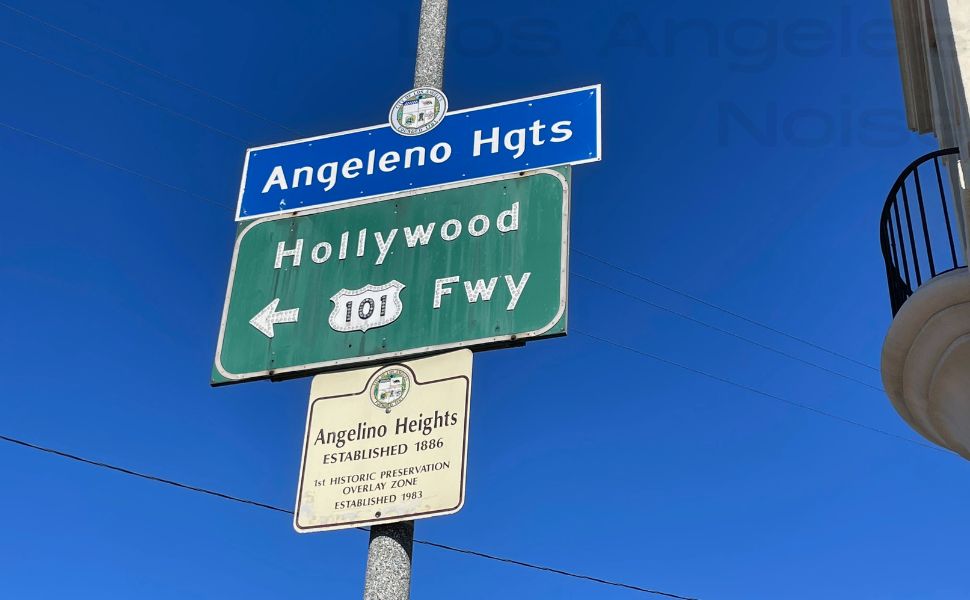
“Eventually, a truce was called. At Bellevue Avenue and East Edgeware Road are two signs that spell out the neighborhood differently: Angeleno Heights is on the highway directional sign; the city’s historical marker uses Angelino Heights.”
DJ Waldie
 Los Angeles Noise
Pingback: NAMM 2025: Time for the Annual Reunion of All Things Musical | Los Angeles Noise