CES, aka The Consumer Electronics Show, kicks off each year with lots of buzz among tech and trends nerds like myself. The last time I wrote about CES was in 2018 with the title, “AI Will Change Our Lives (for better or worse).”
Eight years later, that promise is already taking shape. Corporations are asking their staff to use AI daily, even as they replace people with AI assistants. Every tech product features AI in its advertising. And AI slop is everywhere. You may even doubt a human being wrote this article.
Let’s look back
In that 2018 post, I said the following:
“I can’t help but feel like an ulterior goal [of CES] may be to desensitize consumers and reduce their fears of technology that grows smarter each year. As a result, we grow closer to a future of friendly robots promising to make our lives better. We are more attached to our machines than ever before and one day soon, we may find ourselves unable to distinguish between human and machine interactions.”
As I walked the show this year, it was this article that kept bouncing around in my head. So much of what I saw then has now taken physical shape. Autonomous vehicles were scary in 2018 but are commonplace in several cities today. Here in L.A., Waymo cars are everywhere. When I pulled into the hotel entrance for the show, I spotted a robotaxi before I did a traditional taxi.
Robots everywhere
Today, we interact with AI through our devices. AI is a shapeless brain that outputs what’s been requested. CES presents a vision of AI in the physical world. And yes, that means robots.
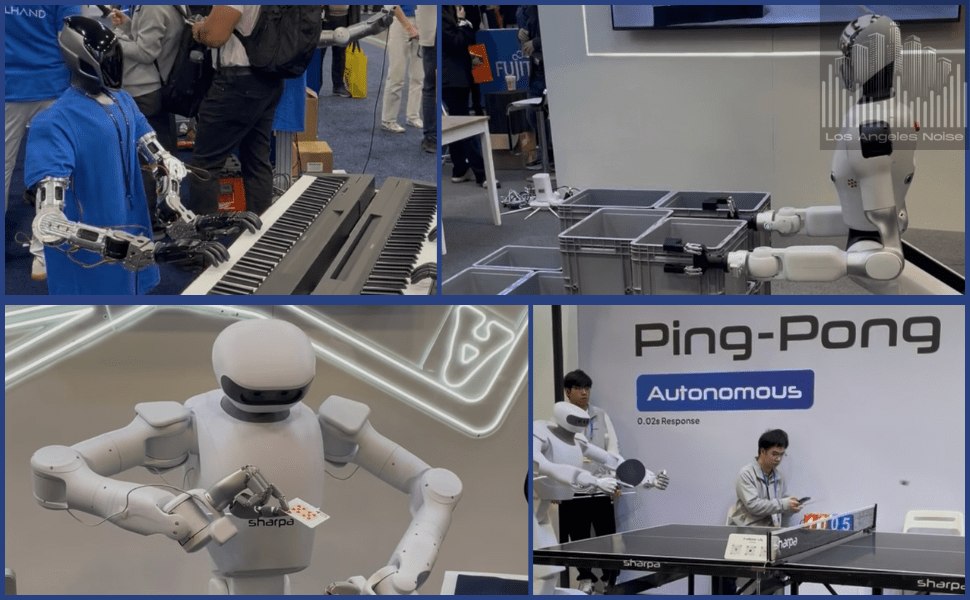
There were robots simulating warehouse work, playing ping-pong, dealing blackjack, and much more. LG had robot assistants around the home with one in particular folding laundry… slowly. The speed of these robots was in fact a key takeaway from this year’s show. Robots can do these things but they are not yet the most efficient solution.
Lost in the hype
The problem with AI as the shiny thing is how it often masks products that address real needs today. One such product was a power wheelchair capable of maneuvering stairs smoothly. For people who walk with difficulty or pain, there were wearable exoskeletons promising to make stairs and other strenuous activities easier.
Another product was a wearable that should be a no-brainer for every sales person: a digital notetaker. Trade show meetings alone would be easier if you could receive an email at the end of the day with transcripts of every meeting you were in.
Others used technology to help us slow down. Remember when people had to think about taking the right picture and wait to see the results? The Await camera was developed to reintroduce that level of patience into photography. When you take pictures with an Await camera, you cannot see the picture you take until 24 hours later. When you take 24 pictures, the company processes your images and sends you the printed “roll.”
Last words on CES 2026
The title I used in 2018 has partially become reality. AI has already changed our lives but it’s not yet clear if it will be for better or worse. AI has made some things easier but it’s also straining our power grids, killing jobs, and creating misinformation and slop.
If everything you read, hear, or see could now be made by a computer, you have to seek out humanity. The CES AI vision magnifies a higher need for face-to-face, in-person interactions. Devices help us communicate but it’s only through eye contact and touch that we truly connect.
 Los Angeles Noise